Moving from primary school to secondary school
Moving from primary school to secondary school is an exciting time for many. For young people and those around them, it can also be an anxious time. This page shares some suggestions and strategies to help you plan as a family for this change.
For a lot of young people, beginning secondary school is a huge life event. It can symbolise entrance into young adulthood. They are also leaving an important part of their lives behind and whether or not they are conscious of it, endings can be difficult.
This transition can be difficult for parents or guardians too. It is a change in routine for the household, which often comes with its own challenges.
Step 1: Share information with the new school
- Clinical assessments or reports - let the school know about any developmental or medical concerns or history.
- Teacher reports from the old school.
- Suggest the old and new teachers link or share information.
- If the school needs further support they can contact the young person's CDNT (contact details for our 11 CDNTs in CHO7).
- Ask the school about language exemption and resource hours, if relevant.
- Talk about special needs assistant (SNA) support, if relevant.
- Identify a point of contact for the child. This could be the year head. Also ask about the possibility of a mentor or peer support for your young person.
- Let the school know about your young person's learning style and areas of strength and need.
Step 2: Create a transition passport/workbook for the new school
- This is a brief summary of strategies to support your young person. The transition passport can support them with preparing for the transition and to feel like the new people will know about them and their preferences.
- Ask your young person's primary school if they have already completed their transition passport. If the primary school hasn't, complete a ‘transition workbook’ with your child - this will be a workbook whereby you collect the same information relevant to your child or young person's transition to secondary school, but it will be written in their voice.
- Distribute the transition passport and/ workbook to all their new teachers.
- There are different types of transition passports, depending on your child’s strengths and needs. See below for some examples - click on the source links to see the documents in full. You can also use these examples as a template for your transition workbook.
Source: NCSE document in full 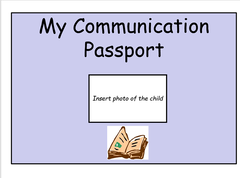 Source: AsIAm document in full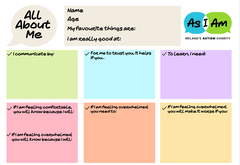
Step 3: Start to prepare your child for the transition
- Make a social story (see our page on Social Stories and Comic Strip Conversations)
- Drive or walk past the school:
- Talk about the school.
- Practice the journey to and from school. Agree on a pick up and drop off point at the school, or plan out the transport options to and from school.
- Make some time to validate the way your young person might be feeling about this move and change.
Step 4: Research the school layout and timetable
Find out the following information on the school website, or by contacting the school:
- Get a map of the school and highlight the key areas. For example, the locker space, lunch area, resource room, sensory room, accessible bathrooms, and pick up and drop off points at the school.
- Find out where the 1st year classes will be held.
- Locate the labs and practical rooms.
- Find out how accessible the school is by identifying where they have stairs and/or a lift. Make sure the lift is working.
- Find out where the student lockers are and what type of locker and size they are.
- Ask if students have a base classroom or move throughout the day.
- Find out what the timetable and lunch routines are.
- Ask if there is unstructured or free time for students.
- Ask what the teachers’ and coordinators' names are.
Step 5: Visit the school with your child before the school year starts
Key contacts in the school would be:
- Principal
- Year Head
- Resource Teacher
- Special Needs Assistant (SNA)
- your Special Educational Needs Organiser (SENO). See here for the national SENO contact list.
When you visit the school:
- Use a map of the school to find your way around.
- Meet teachers if possible. Identify a support person that your young person can talk to or go to if upset.
- Take photos of classrooms, the toilets, the yard, and teachers, if possible.
- Bring a snack and eat where your child will be eating next year, and use the toilets.
- Afterwards, create a picture book using photos taken on the visit.
- Get your child involved by allowing them to glue in photos into their picture book.
- Agree with the school what allocations your young person will have, for example, if they find the canteen overwhelming, can they be allowed to leave class early; or if they are late to class, that they will not be penalised or given out to.
Step 6: Consider the classroom environment and curriculum
Consider the following supports and requirements for your child:
- Assistive Technology (AT)
- If a young person has existing assistive technology sanctioned from primary school, this should go with them to secondary school. It is important for parents to link with the primary school or SENO (Special Educational Needs Organiser) so your young person child continues to use AT when they transition to secondary school.
- Ask if it would be possible to communicate with teachers or if homework could be shared using a communication book or through an app like Aladdin that enables school and home to communicate with each other.
- Consider where your young person will be sitting in the classroom is also helpful, for example, an independent work station, sitting at the top or back of class, or sitting at a desk alone.
- Ask what exam accommodations and supports are available to young people, if required.
- Explain your young person's sensory needs. Referring back to what is included in their transition passport here is key. The primary school may be able to share information about the young person’s sensory preferences within the school environment and some strategies that worked well to support them.
- Something to consider also is how the secondary school environment can adapt to your young person's sensory needs. For example, if they are sensitive to noise, can they be accommodated to leave class before their peers to avoid busy hallways; is it possible for them to leave the classroom when it becomes too noisy; can teachers be made aware so they can control their voice level accordingly.
- Discuss helpful strategies that would support your child with school, for example, a locker at the end of the row at eye level, or keeping books in the resource room if a busy locker area may be overwhelming during breaks or if lockers would be difficult to manage.
- Ask if there is a quiet area or space for your young person to take a break if required. Use of a ‘break card’ may be useful to help the young person to communicate that they need to leave class. See examples of break cards in these communication cards from AsIAm.
- Talk to the school about how your child best takes in information. Think about if it is visual, auditory, or in text form.
- Think about tools that might help like visual cues including using coloured paper or a ruler under a sentence being read. Highlighters can be very useful too.
- Think about using visual timers like sand timers or digital timers at home.
- Talk to the school about reducing visual stimuli. For example, explain the importance of having one subject on the board at a time.
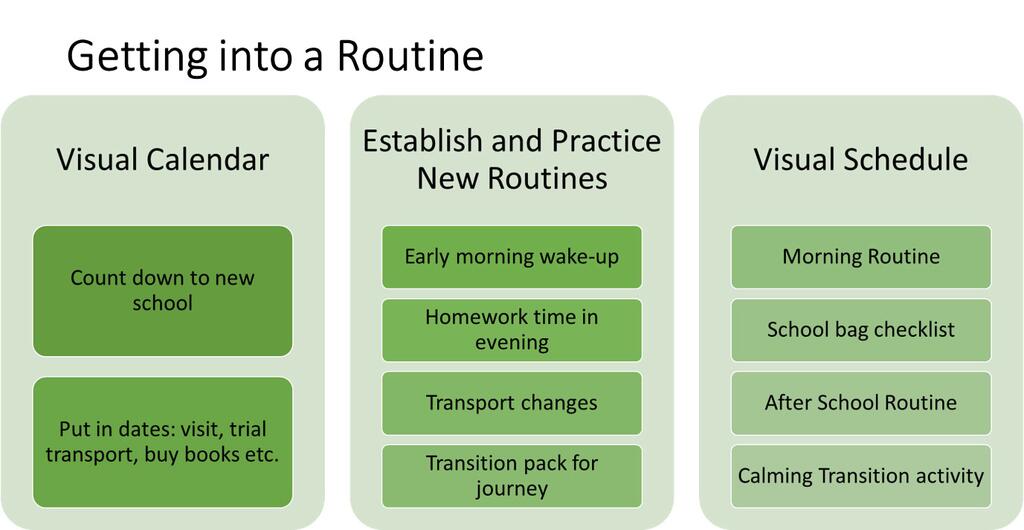
- Transition pack for journey – this might be a collection of activities or useful items that you can pack with your child or young person to use on their way to school. The pack is there to support your child or young person with their journey to their new school setting. For example, you might pack:
- noise-cancelling headphones
- a portable sensory kit which includes their favourite sensory items, for example, fidget toys (stress balls, spinners, or stretchy bands for self-regulation).
- a tablet, book, or favourite puzzle if you are travelling a distance or stuck in traffic.
- snacks or a water bottle.
- Calming transition activity – this might be where you have a planned activity ready to do if your child or young person becomes dysregulated. It may be something you include in your transition pack for a journey, like a tablet with favourite music or a favourite video, a favourite book.
See our page on Visual Supports
See this example from Middletown Centre for Autism on Packing a School Bag.
Further information:
- AsIAm Finding a School Place
- Enable Ireland Strategy on Learning to Organise for School
- Middletown Visual Schedule: Homework schedule
- Middletown Visual Schedule: Packing my schoolbag
- Middletown Visual Schedule: Things to remember for school
- Middletown Sensory Map (with school-related sensory strategies and supports)
- NCSE Changing Schools: Moving from Primary to Post Primary School
- NCSE Supporting Students with Special Educational Needs to make Successful Transitions
Page last reviewed: 19 February 2025
Next review due: 19 February 2026