What is Emotional Regulation?
Emotional regulation is a term used to explain how someone manages or controls their emotional responses to situations.
For children, it’s about how they learn to deal with difficult emotions, control their impulses and calm themselves down. It’s also about how they learn to respond to emotions and prevent them from becoming dysregulated (unable to regulate their emotions).
We are not born with the ability to self-regulate. This skill is learned over many years, and it changes as we get older into adulthood.
Children learn how to regulate themselves from their parents and caregivers through a process called co-regulation, which are the soothing, respectful, and nurturing interactions you have with your child. Co-regulation is a pre-cursor to your child learning to self-regulate.
As parents, you can demonstrate and model your own self-regulation through this process of co-regulation. A regulated adult can help a child to remain calm and regulated. Children with sensory differences may often rely on those around them to help them to regulate their emotions.
What can I do as a parent if my child has difficulty regulating emotions?
- Accept your child’s emotions and emotional responses: Emotional outbursts are a normal part of development. By having patience and ‘tuning in’ to your child’s emotional states, you can help them understand and cope with different emotions that they experience.
- Appropriate expression of feelings of overwhelm, upset, or anger: All feelings are okay and normal. Feelings of overwhelm, upset, or anger can be put into words and children can be praised when they do this in appropriate ways.
- Encourage children to talk about feelings and avoid directives about feelings: Avoid statements such as ‘Don’t be sad’. Instead label the child’s feelings accurately and encourage the child to talk about the emotion, such as ‘I see you are sad about that, tell me about it’.
- Model emotional regulation: Children are likely to imitate your example. As a parent you can model appropriate ways to express emotions by labelling your own emotions, talking about how you feel in different situations, and modelling how to express emotions in an appropriate way.
- Talk about your own feelings: Parents who frequently use the language of emotions to talk about their own emotional states are providing a good example for their children to observe and learn from.
- Teach children positive self-talk about the event: Teach children to tell themselves thoughts which calm them down such as ‘everyone makes mistakes’, ‘I can handle this’ and ‘it was an accident’. Using previously learnt positive phrases, such as ‘I can handle this’, can be helpful as a coping strategy to manage difficult situations.
- Teach problem solving: Teach children to generate several solutions to a problem and then select one based on their pros and cons.
- Help children recognise ‘early warning signs’: Help children to recognise how their body feels (body cues). Teach children to recognise when they are becoming overwhelmed or dysregulated by tuning into their bodies. Teach strategies that they can use to regulate themselves at these times. If your child can talk about their feelings at this stage, it can help avoid escalation.
- Help children with transitions: Plan ahead for the daily schedule and give verbal warnings 5 to 10 minutes before transitions. A visual schedule may help to show the order of different activities.
Practice calming relaxation techniques: Practice strategies that can help your child to calm such as the ‘Turtle Technique’ which involves imagining that he or she is retreating into his shell, taking three deep breaths and saying ‘calm down, take deep breaths’. The child can imagine they are ‘pushing’ the air into their arms and legs to relax their muscles.
There are many different ways to regulate: For example, breathing activities, movement, a preferred hobby, removing yourself from a situation, accessing or removing sensory input. Activities to support regulation will differ from person to person and often requires a trial and error approach to find what works.
- Provide a stable and consistent environment: Consistent limit setting, clear household rules and predictable routines help children know what to expect. Visual schedules or supports may be helpful to support understanding of routines.
- Remember the basics: To help keep a child regulated, remember the importance of sufficient sleep, appropriate diet, exercise and engaging activities.
- Find a quiet zone in the house
- Mark out the zone and make it cosy. For example, use a tent or curtain to define the space, and put in a bean bag, pillows and comforting items such as stuffed animals.
- Add some calming items. For example, music, fidget toys, lava lamp, or therapy ball, and include visual cue cards to give visual reminders of calming activities. Calming items will vary greatly from person to person.
- Explain how to use the calm zone and practice calming techniques.
- Encourage your child to use the quiet/calm zone throughout the day. Practise using the calm zone when they are regulated, so they are familiar with it and may be able to access it when dysregulated or overwhelmed.
- Aware: Become aware of your child's emotions, especially if it is low intensity, such as disappointment or frustration.
- Connect: View their emotions as opportunities for connection and teaching. These everyday natural opportunities build emotional awareness.
- Accept: Listen and accept their emotions, and avoid judgement. Be with the child’s emotions. What helps children the most is having us with them in their emotions rather than us trying to stop them from feeling how they feel. Confirm what they are feeling by naming it and reassuring them. Knowing that we do not have to be alone when we are upset is at the heart of feeling emotionally secure.
- Reflect: Help them use words to describe what they feel.
One of the most important things we can do for a child who is upset or distressed is to just be with them. By showing our child that we can be with them when they are feeling dysregulated, we are showing them that all feelings, even big uncomfortable ones, are ok.
We can be with our child by:
- Pausing our own agenda or plan for that moment when a child becomes upset.
- Showing them with our body language that we are in the moment with them, for example, by getting down to their level.
- Using your facial expressions and body language to let your child know that you are there to support them.
- Reducing language used in these moments. Make your child aware in simple clear language that you are there for them and help them to feel safe.
Have a Routine
The use of daily routines can provide structure and predictability.
Routines help everyone know what to expect, and what is coming next.
Creating a visual schedule together is a nice way to ensure everyone is aware of the plan for the day. You can use pictures, drawings, write the words or all of the above. The schedule can include times for school, free play, mealtimes, outdoor play, screen time and chores. By increasing predictability, routines can help support regulation across the day.
See our page on Visual Supports for more information about visual schedules
Introduce Visual Scales, if appropriate for your child
Using a visual scale such as an emotional thermometer, or a 5-point scale may be useful. This is a visual system that can help organise your child’s thinking when they are working through difficult moments. When you first introduce this system, work together to create their own labels for each level – these could be words, colours or numbers.
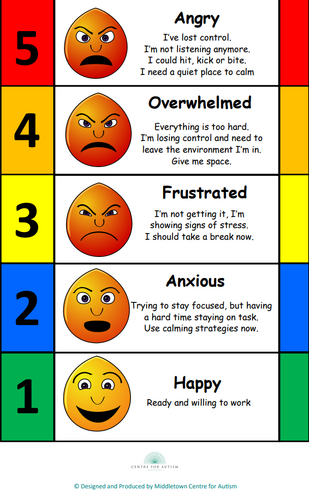
Source: Middletown Centre for Autism - see here for further examples and templates you can use
For a child who is a visual learner you might start to associate different colours with different states, for example, green with happy and red with frustrated. Next, add pictures to teach what different levels might look or feel like and identify coping strategies that might be useful at the different levels, for example, taking a break, or showing a ‘help’ card’ (see under ‘Coping Strategies’ below for more on this).
First, practice using the scale when your child is regulated. Later, you can show the scale when you sense your child is becoming dysregulated and use it to help them identify that feeling and remember some of their coping strategies. As a parent, using the same scale may also be helpful. If you practice together using it, it will then become part of your family's routine. The young person may become familiar then with using it and be able to access it at times of upset or distress.
Introduce Social Stories or Comic Strip Conversations
If appropriate, using a social story that incorporates how your child feels and more appropriate ways to react to a situation may be useful. Social stories can be helpful if there is a particular situation that brings up feelings for your child that they find difficult to manage, such as losing a game, or waiting for their turn. In the social story, explain the feeling, but give some solutions about better ways they could respond to the feeling. Comic strip conversations, if appropriate, can also be another way to support your young person's understanding of a social situation.
Teaching Coping Strategies
Coping strategies are likely to be taught slowly, with lots of practice. These might include taking 5 deep breaths, asking for help, or walking away and spending time alone.
Coping strategies are best practised when a child is calm and alert for learning. When they become very familiar they can be used when the child is dysregulated. Again, pictures, signs and actions will be helpful.
When teaching deep breathing you could use the actions ‘Smell the Flowers’ for the inhale and ‘Blow out the Candles’ for the exhale. A ‘help card’ is a visual that a child can show to an adult to indicate that they need help. You could also teach the child a sign to communicate this, for example, ‘showing 5 fingers’ could symbolise ‘I need 5 minutes' or 'help’.

Calm Kit /Regulation toolkit
A calm kit is a practical strategy to help a child self-manage big emotions. The goal is that the child will feel more relaxed and regulated after engaging with items in the kit. Consider options for making the child's calm kit portable. It should always be easily accessible. For example, they can have a mini box in the car or smaller items in their pockets.
Items to include might be: fidget toys, music, calming items such as stress balls or bubble wrap, pictures or items related to a special interest.
When your child has become dysregulated
- Model emotional regulation as the parent
- Use a calm voice with them
- Use clear and consistent language
- Acknowledge and validate your child's feelings
- Support them to find the calming techniques that work best for them in that moment.
Videos
This four-part series on Emotional Regulation was delivered by the psychology team in the North Wicklow CDNT as part of a webinar workshop series for parents of children with disabilities and specifically children with regulation challenges.
To turn on closed captions (subtitles) or read the transcript: When the video starts playing, if you are on a desktop, click the "CC" icon at the bottom of the video. If you are on a mobile device, then at the top of the video, tap "CC" to enable closed captions. To disable the closed captions, tap the "CC" icon again. Watch the video on its YouTube channel to see the transcript.
Further information
On this website
- Neurodiverse communication
- Sensory processing
- Social Stories and comic-strip conversations
- Visual Supports
Books
The Incredible 5-point Scale: Assisting Students in Understanding Social Interactions and Controlling Their Emotional Responses (2nd Edition, 2012)
The Explosive Child: A new approach for Understanding and Parenting Easily Frustrated, Chronically Inflexible Children 6th ed, Ross W Greene, Ph.D., Harper, 2021
The Incredible Years (R): Trouble-Shooting Guide for Parents of Children Aged 3-8 years, Carolyn Webster-Stratton, The Incredible Years, 2019
Website
Creating a Calm Zone at home by Middletown Centre for Autism
Video
This video shows you how to practice a simple breathing exercise to help you relax