Toilet training tips - Part Three - Common Difficulties
We have three pages on toilet training tips. This is part three which looks at some of the common difficulties parents have when toilet training.
- Simplify your language, for example, say: ‘Time for potty’ v’s ‘Do you need to use the potty now?’
- Visual schedule to help with predictability (to know what’s coming next) and remembering the steps.
- Pay attention to your child’s gestures or body language (for example, rubbing their tummy, becoming upset, leading you to the toilet, rubbing their bum).
- Model language if you see a gesture (for example, pulling at their underwear, say ‘time to go potty’).
- Keep a toileting record to identify your child’s pattern and adjust the toilet times to match these times.
- Plan toilet times after meals, sleep or exercises
- Give your child a big drink 10 minutes before toilet time to increase likelihood of your child doing a pee.
- Set limits to where your child can use nappy for poo e.g., only in the bedroom
- Gradually limit its use to the toilet
- Remove nappy when they are finished and encourage them to help clean up as much as possible.
- Encourage them to empty the poo into the toilet because that is where poo goes.
- Use hand-over-hand assistance and slowly move to verbal prompting over time.
- Hand-over-hand assistance is where the adult places his or her hand on the child’s hand to guide them in completing a task. It is often used for teaching children how to acquire a skill, such as self-care skills, like holding a toothbrush or, in this case, toileting. The goal of hand-over-hand assistance is to fade it out as the child develops a better grasp on the skill.
- Use the long mirror in bathroom to self-check.
- Backward chaining
- The adult starts the task and the child finishes off the very last part. To teach the child to wipe their bottom after using the toilet, the adult would do most of the wiping and the child would complete the last, “check it’s clean” wipe themselves.
- Gradually encourage the child to start earlier and do more of the task as they get better at it.
- There are some games that can help with reaching for bottom wiping, please see: See this NHS information sheet for examples of bum wiping games and activities
- Don’t force the child to stay in the room when flushing.
- Shut the lid to reduce the noise of the flush.
- Let them stand just outside the door while you flush and gradually get them to stand closer until they can do the flush.
- Show the workings of the toilet so they can understand what is making the noise.
- Use ear plugs or ear defenders to block the noise of the flushing. This would be helpful in public.
- Use hand-over-hand assistance and slowly move to verbal prompting over time.
- Outside of toileting time, consider playing games or completing activities with your child that involve using two hands (for example, throwing and catching a ball; clapping in time to music; using scissors; holding onto a swing).
- Physically cover toilet handle to remove it from sight.
- Give them something else to hold and manipulate.
- Use a visual sequence to show when to flush (after replacing clothing, for example).
- When it’s time to flush, give your child a sticker that matches to a sticker on the toilet handle, as a visual prompt that they are now allowed to flush the toilet.
- Most toilets have an easy to turn valve under the toilet tank which can be used to turn off water supply in extreme situations.
- Try alternatives for example, a wet sponge or wet wipes and then toilet paper to dry.
- Use labelling language when doing this such as the ‘wet wipe is wet’; ‘toilet paper is dry’.
- Let your child choose a smell you both like.
- Try lavender or chamomile for over-sensitive children, or citrus smells to increase arousal. Be aware of allergies.
- See also this NHS information sheet for further ideas
- Use rubber gloves for wiping.
- Consider messy play activities – sand; water; finger painting etc.
- Social stories or videos that can tell the child how poo is made and what to do if I have a poo. This promotes an understanding of the body and they have a plan for how it can be removed:
- Labelling or modelling intereoceptive awareness*, for example, what is ‘hot/ cold’; feeling thirsty; or 'Mummy has a scratchy throat, it’s hard to talk'. In the case of toileting that might be:
- For the child: if they are pulling at their underwear: ‘does poo need to go into the toilet?”’
- For the parent: ‘When mummy needs to use the toilet, her tummy feels tight, mummy needs to push”’.
- External strategies, to help the child know that the feeling of poo has an end point, such as:
- Alarms
- Routines (for example, we sit on toilet first, then football).
*Intereoceptive awareness = intereoception is our eighth sense. It is the sense we have of the physical signals we get from our body, for example, feelings of hunger, thirst, thirst, body temperature, and digestion. Intereoceptive awareness is our understanding of those internal workings within our own bodies.
See our page on Sensory Processing to learn more about our eight senses.
- A social story about where we go to the toilet.
- Completing all toileting-related activities in the bathroom (for example, changing their nappy or cleaning up after an accident).
- See this booklet from ERIC, When it's time to go, it's time to go, a wee and poo adventure
- Use of a visual schedule: routine and predictability can help reduce anxiety.
- Consider the sensory environment, removing unpleasant items for your child.
- Use of rewards.
- Social story about what happens in the toilet (for example, pee and poo).
- Check for constipation.
- See this animation from ERIC, the Children’s Bowel and Bladder Charity, which explains how to identify and treat childhood constipation
- See also the ERIC poo checker chart here.
- Establish habits (for example, look at their toilet chart and when they would typically poo).
- Check their seating position on the toilet/potty
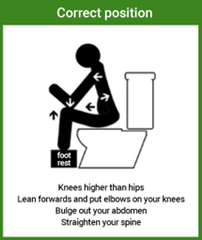
Source: NHS
- Look at options to increase their tactile (touch) sensory input in other ways, for example wearing tightly fitting clothing or fiddle toys.
- Allow the child to wear tight fitting pants, leggings or shorts.
- Provide deep pressure in other ways, for example, massage or tight clothing
- Gradually reduce the tightness of the nappy as the child gets more confident.
- They may want the sensation of the nappy but may not understand why it is being taken off. If so, a social story would be helpful.
- Check your child’s health for infection or constipation
- Re-establish a daily routine for taking child to toilet, using visuals and immediate praise and rewards.
- Use a toilet record to establish how many accidents are occurring
- If the family routine has changed, slow down your toileting expectations.